Thursday, August 8, 2013

1/72 Italeri F19 USAF

Hey everyone,

Hope things are going well with your models. Anyways, here is a new post about probably the rarest aircraft I have ever built.

1/72 Italeri F19 USAF

 This one was really cool and easy to build. Not really too much to say about this one in terms of building because it was pretty easy.

The overall colour is NATO Grey, the interior is Flat Black with a Clear Green targeting screen. The missiles are White
 The F19 was/is a suspected top secret aircraft that may have been/is in production or testing. The reason many think it exists is because of the name scheme for fighters.

It has progressed from F1 in order all the way up to F22, and not including F13 for superstitious reasons. But there is also no aircraft named F19 in the USAF.
 So this has led to speculation that it may be top secret. Italeri tried to make it seem interesting by saying when the aircraft model was released it created an uproar in the American senate.

Total BS, but whatever floats their boat haha.

Anyhow, this one is a cool one in my collection and I use it as if it really exists.


Wednesday, August 7, 2013

1/72 Trumpeter Shijiazhuang Y-5 PLAAF

Good morning world,

Hope all is well and the battles in your model world aren't too tough for the good guys haha. Monday's post is coming together well and you should be satisfied with it.

So here is another "Exotic" model for you to take a gander at.

1/72 Trumpeter Shijiazhuang Y-5 PLAAF

 Due to a lot of possible spelling mistakes I will just call this aircraft by its original name, Antonov AN 2.

This aircraft was a pain in the ass to build as the wings were too high so I had to use weights to lower them and allow the support struts to connect.


 I don't think this model had the interior section but getting the fuselage to stay together was still tough so I used elastic bands like usual.

Overall the aircraft is NATO Green with a Light Grey underbelly. The interior is Neutral Gray with Red cockpit seats and a Flat Black control panel, wheels, and propeller. The engine is Gun Metal while the propeller tips are Flat Yellow.
 This aircraft is nearly 100 years old yet it is still widely used by civilians for crop dusting and bush flying in the outback parts of the former Soviet states. The AN2 was originally developed as a transport to provide lifelines to remote locations in Russia.

China first received their aircraft in the 60's and still operates them in many military roles including medivac, troop transport and combat drops. I was surprised when I saw that the PLAAF still uses them but with a rugged design and reliability as well as flight upgrades it isn't too big of a surprise. I suspect this aircraft will be part of the PLAAF well into their hundredth year as it is hard to replace a reliable Ukrainian design.
General characteristics
  • Crew: 1–2
  • Capacity: 12 passengers
  • Length: 12.4 m (40 ft 8 in)
  • Wingspan:
    • Upper wing: 18.2 m (59 ft 8 in)
    • Lower wing: 14.2 m (46 ft 9 in)
  • Height: 4.1 m (13 ft)
  • Wing area: 71.52 m² (769.8 ft²)
  • Empty weight: 3,300 kg (7,300 lb)
  • Loaded weight: 5,500 kg (12,000 lb)
  • Useful load: 2,140 kg (4,700 lb)
  • Powerplant: 1 × Shvetsov ASh-62IR 9-cylinder supercharged radial engine, 750 kW (1,000 hp)

Performance
  • Maximum speed: 258 km/h (139 kn, 160 mph)
  • Cruise speed: 190 km/h (100 kn, 120 mph)
  • Stall speed: ~50 km/h (26 knots, 30 mph)
  • Range: 845 km (456 nmi, 525 mi)
  • Service ceiling: 4,500 m (14,750 ft)
  • Rate of climb: 3.5 m/s (700 ft/min)
  • Power/mass: 0.136 kW/kg (0.083 hp/lb)


(All info from Wikipedia and the instruction sheet)

Tuesday, August 6, 2013

1/72 Trumpeter Hongdu JL-8 PLAAF

Gooday everyone,

Sorry for the recent inactivity, I've been busy trying to construct all my models before I head out west in a weeks time and that is a lot of models (With more expected in the mail :$).

Anyways, so what that means is that on August 12th, the second season of modeling will come to a close, and that also means I have begun working on the final post for season 2. It will be more than one model and I have already built all the models I expect to post for it so all I need is the right wording.

1/72 Trumpeter Hongdu JL-8 PLAAF

For this batch I have decided to start off with one of my smaller and more favored aircraft, the nimble  Hongdu JL-8. I found this guy at Aviation World near the Toronto Pearson airport and was at first skeptical about purchasing it, but after I did and built it I was happy I decided to do so.

 The one thing I like about Trumpeter is that their planes always go together without so much as a hitch or snag and this little guy was no exception. And easy assembly was only made better by the white spray paints willingness to cooperate.

The fuselage is overall White with Red underside and control surfaces. The engine is Gun Metal while the interior is Neutral Grey.The engine nacelles are silver


This little aircraft serves the same purpose as the CT-133 or the Hawk. It is an intermediate jet trainer that some of its users have used as an attack aircraft.

I personally think this plane is really cute and that the red on white really looks good. The main users are the Peoples Liberation Army Air Force (China) and the Pakistani Air Force. In fact, the PAF uses their JL-8's not just as trainers and attack aircraft, but also in their aerobatic teams (Like the Snowbirds or Blue Angels.)
General characteristics
  • Crew: 2 (in tandem)
  • Length: 11.6 m (38 ft 0 in)
  • Wingspan: 9.63 m (31 ft 7 in)
  • Height: 4.21 m (13 ft 9 in)
  • Empty weight: 2,687 kg (5,924 lb)
  • Max. takeoff weight: 4,330 kg (9,546 lb)
  • Powerplant: 1 × Garrett TFE731-2A-2A turbofan, 16.01 kN (3,600 lb)
Performance
  • Maximum speed: Mach 0.75 (800 km/h, 498 mph)
  • Range: 2,250 km (1,398 mi)
  • Service ceiling: 13,000 m (42,651 ft)
  • Wing loading: 254.40 kg m-2 ()
  • Max. airframe load factor: +7.33 g / -3.0 g

Armament
  • Guns: 1× 23 mm cannon pod (mounted on centreline hardpoint)
  • Hardpoints: 5, total capacity 1,000 kg (2,205 lb) external fuel and ordnance:
  • 4× under-wing, capacity 250 kg each
  • 1× under-fuselage (23 mm cannon pod mount) 
  • Rockets: 57 mm unguided rocket pods, capacity 24 rounds (2 x pods with 12 rounds each)
  • Air-to-air missiles: PL-5, PL-7
  • Bombs: 200 kg, 250 kg unguided bomb, BL755 cluster bomb
  • Others: 
  • 2× 80 gal fuel drop-tanks mounted on outboard under-wing hardpoints 

Avionics
  • EFIS
(Info provided by Wikipedia)

Thursday, August 1, 2013

1/72 "Classic" F15 Eagle USAF

1/72 "Classic" F15 Eagle USAF


 You may be saying to yourself, "I have never heard of this model manufacture called 'Classic' before." Well that is because the model is not by a company called classic, rather it is a classic kit that I don't remember what the company was. It wasn't one of the regular companies I usually build from (revell, air fix, etc) so I am not sure on the name.
 But here it is, the F15 Eagle, America's former most advanced and top-of-the-line air-to-air fighter. I say former because the F22 is newer and much more capable.

Anywho, this kit was easy to assemble, and thanks to being from the 80's, it didn't have an excruciating amount of decals to apply. The only thing I had trouble with was when I realized the 2 seater version was a training only variant.

What did I do to overcome? I simply cut away the panel and pulled the seat out. I then took the piece that is normally applied behind the pilot and covered where the former back seater used to sit. I can't tell if something used to be there to it turned out good.

The over all colour is the darker IJN Grey, while the canopy is painted Neutral Grey (I hadn't figured out that Neutral Grey matched the lighter IJN Grey when building this guy). The missiles are White with the engines being Gun Metal. All in all, it turned out great.
It was almost as hard finding this aircraft as it was trying to find the A10 from earlier, but I found it for a very reasonable price and am glad it is in my inventory now. The F15 is probably my favorite aircraft after the 80's as the F104 is my favorite preceding it.

The F15 Eagle was the USAF's top of the line fighter aircraft. It was nearly unmatched by anything produced by the Soviets and was the first true modern air superiority fighter. It proved itself during the Gulf War when they took on Saddam Husein's Air Force to help liberate Kuwait. It still serves today to protect American airspace from harm much like the F16. A new variant of the Eagle is currently in testing known as the 'Silent Eagle' due to its stealth capabilities. Low operating costs and a reliable airframe means this vehicle will serve well into the 21st century.

General characteristics
  • Crew: 1: pilot
  • Length: 63 ft 9 in (19.43 m)
  • Wingspan: 42 ft 10 in (13.05 m)
  • Height: 18 ft 6 in (5.63 m)
  • Wing area: 608 ft² (56.5 m²)
  • Airfoil: NACA 64A006.6 root, NACA 64A203 tip
  • Empty weight: 28,000 lb (12,700 kg)
  • Loaded weight: 44,500 lb (20,200 kg)
  • Max. takeoff weight: 68,000 lb (30,845 kg)
  • Powerplant: 2 × Pratt & Whitney F100-100 or −220 afterburning turbofans
    • Dry thrust: 17,450 lbf (77.62 kN) each
    • Thrust with afterburner: 25,000 lbf for −220 (111.2 kN for −220) each
  • Fuel capacity: 13,455 lb (6,100 kg) internal
Performance
  • Maximum speed:
    • High altitude: Mach 2.5+ (1,650+ mph, 2,665+ km/h)
    • Low altitude: Mach 1.2 (900 mph, 1,450 km/h)
  • Combat radius: 1,061 nmi (1,222 mi, 1,967 km) for interdiction mission
  • Ferry range: 3,450 mi (3,000 nmi, 5,550 km) with conformal fuel tanks and three external fuel tanks
  • Service ceiling: 65,000 ft (20,000 m)
  • Rate of climb: >50,000 ft/min (254 m/s)
  • Wing loading: 73.1 lb/ft² (358 kg/m²)
  • Thrust/weight: 1.12 (−220)

Armament
  • Guns: 1× 20 mm (0.787 in) M61 Vulcan 6-barreled gatling cannon, 940 rounds
  • Hardpoints: Total 11 (not including CFTs): two under-wing (each with additional two missile launch rails), four under-fuselage (for semi-recessed carriage of AIM-7 Sparrows) and a single centerline pylon station, optional fuselage pylons (which may include conformal fuel tanks, known initially as Fuel And Sensor Tactical (FAST) pack for use on the C model) with a capacity of 16,000 lb (7,300 kg) and provisions to carry combinations of:
    • Missiles:
      • 4× AIM-7 Sparrow
      • 4× AIM-9 Sidewinder
      • 8× AIM-120 AMRAAM
    • Bombs:
      • Mark 82
      • Mark 84
      • GBU-8
      • GBU-10
      • GBU-31
    • Other:
      • up to 3× 600 US gallons (2,300 L) external drop tanks for ferry flight or extended range/loitering time.
      • MXU-648 Cargo/Travel Pod – to carry personal belongings, and small pieces of maintenance equipment. 
 
 Avionics
  • Radar:
    • Raytheon AN/APG-63 or AN/APG-70 or
    • Raytheon AN/APG-63(V)1 or
    • Raytheon AN/APG-63(V)2 Active Electronically Scanned Array (AESA) or
    • Raytheon AN/APG-63(V)3 Active Electronically Scanned Array (AESA)
    • Joint Helmet Mounted Cueing System
  • Countermeasures:
    • Northrop Grumman Electronic Systems AN/ALQ-131 electronic countermeasures pod
    • Hazeltine AN/APX-76 or Raytheon AN/APX-119 Identify Friend/Foe (IFF) interrogator
    • Magnavox AN/ALQ-128 Electronic Warfare Warning Set (EWWS) – part of Tactical Electronic Warfare Systems (TEWS)
    • Loral AN/ALR-56 Radar warning receivers (RWR) – part of TEWS
    • Northrop Grumman Electronic Systems ALQ-135 Internal Countermeasures System (ICS) – part of TEWS
    • Marconi AN/ALE-45 Chaff/Flares dispenser system – part of TEWS

    All info from wikipedia and the National Museum of the United States Air Force

Wednesday, July 31, 2013

1/72 Airfix Sikorsky CH-124 Sea King Canadian Forces (Navy)

1/72 Airfix Sikorsky CH-124 Sea King Canadian Forces (Navy)

 This is a model that I highly recommend for those who enjoy making their models participate in missions. You may be asking why? It is simply because this is the only model I have built with the capability of having the landing gear raise and lower as well as have the main door open and close. It is truly a splendid model.
 The kit was for the Royal Navy and has the option of having an early warning radar on it, but I wanted it to make it Canadian. As per usual, I used decals from the 'Canadian Helicopters' decal sheets from Belcher Bits models, but because I used the latest coloured roundels on the Chinook, I decided to make it the next latest, but it still looks fairly modern.
 Construction went on without a hitch but I did think it was very interesting that the model allows for wheels up and down as well as the door open/closed with the ability to slide it into those positions. You can see this in the picture to the right where the wheels are up and the door shut.
Over-all the aircraft is Ocean Gray (RAF) with a Neutral Gray interior. All the black parts are Gloss Black with Yellow rotor tips. The wheel wells are NATO Green and the struts are Flat Aluminum.


The Sea King has served the Canadian Forces as a Search And Rescue (SAR) helicopter as well as submarine hunters. 2013 marks the 50th anniversary of the Sea King's first flight with the Canadian Forces. Since then it has served in virtually every combat mission since then and has rescued countless numbers of lives at sea and abroad.
File:CH-124 Sea King.jpg


Despite the trusted service the aircraft has provided, it will not last. In 2009 Canada ordered the CH-148 as a replacement with delivery expected immediately. But as it is 2013 and we only have two, the Sea King will remain in service in the foreseeable future until more Cyclones arrive.

General characteristics
  • Crew: 4 (2 pilots, 1 navigator, 1 airborne electronic sensor operator)
  • Capacity: 3 passengers
  • Length: 54 ft 9 in (16.7 m)
  • Rotor diameter: 62 ft (19 m)
  • Height: 16 ft 10 in (5.13 m)
  • Disc area: ft² (m²)
  • Empty weight: 11,865 lb (5,382 kg)
  • Loaded weight: 18,626 lb (8,449 kg)
  • Max. takeoff weight: 22,050 lb (10,000 kg)
  • Powerplant: 2 × General Electric T58-GE-8F/-100 turboshafts, 1,500 shp (kW) each
http://img291.imageshack.us/img291/6184/serverfx7.jpg
Performance
  • Maximum speed: 166 mph (267 km/h)
  • Range: 621 mi (1,000 km)
  • Service ceiling: 14,700 ft (4,481 m)
  • Rate of climb: 1,310-2,220 ft/min (400-670 m/min)

Armament
  • 2× Mk 46 Mod V anti-submarine torpedoes
  • Various sonobuoys and pyrotechnic devices
  • door guns (some variants)
Info from 'RCAF Today' Magazine and Wikipedia.


http://www.forces.gc.ca/site/commun/ml-fe/images/articles/fullSize/09-16-08a.jpg

Monday, July 29, 2013

1/72 Minicraft CF-188 Hornet RCAF

Hey everyone,

Glad to see the numbers continuing to rise. Even if it is just people returning I am glad that you are. Anyways, I hope all is well in you modeling world and that some of my posts have helped make your models good.

1/72 Minicraft CF-188 Hornet RCAF

 I made this one a long time ago and can't really say I remember what colours I used or how well the construction went. I do know that the decals did come with the model and that I painted it by hand as I hadn't yet discovered sprays.
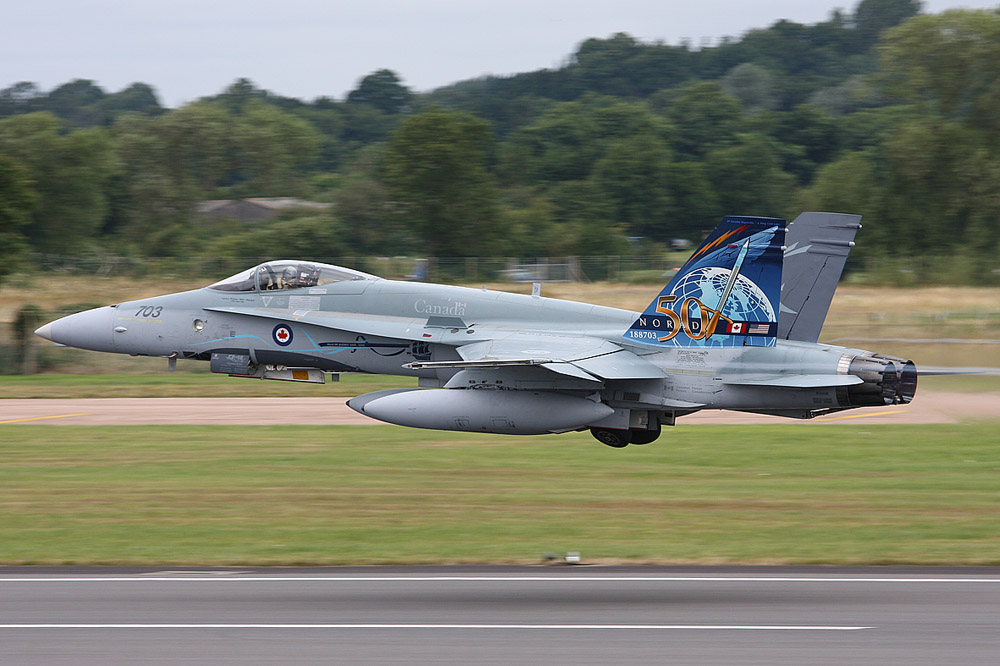
 The Hornet has served as Canada's only fighter/bomber for three decades and has participated in every combat mission since then including the Gulf War, peace keeping in the states of former Yugoslavia, Afghanistan, Somalia, and even the no fly zone over Libya.


 The aircraft was first introduced in 1983 but was less than admirable to its pilots in the first years as they were used to the CF-104, CF-5 and the CF-101 which were relatively sluggish compared to this aircraft.

Also, since this aircraft was purchased right from McDonnell instead of through the USAF so the pilots didn't receive any training on this aircraft
But once the RCAF got used to it, the Hornet became one of the most reliable aircraft ever to serve in the Canadian Forces and finding a replacement will be tough.


General characteristics
    File:CF-188B 410 Sqn with 60th anniversary paint.JPEG
  • Crew: 1 or 2
  • Length: 56 ft 0 in (17.07 m)
  • Wingspan: 40 ft 0 in with Sidewinders (12.31 m)
  • Height: 15 ft 4 in (4.66 m)
  • Wing area: 400 ft2 (37.16 m2)
  • Airfoil: NACA 65A005 mod root, 65A003.5 mod tip
  • Empty weight: 23,049 lb (10,455 kg)
  • Loaded weight: 37,150 lb (16,850 kg)
  • Max. takeoff weight: 51,550 lb (23,400 kg)
  • Powerplant: 2 × General Electric F404-GE-400 turbofans, 16,000 lbf (71.2 kN) each

Performance
  • Maximum speed: Mach 1.8 (1,127 mph, 1,814 km/h) at 36,100 ft (11,000 m)
  • Combat radius: 330 mi (290 nmi, 537 km) on hi-lo-lo-hi mission
  • Ferry range: 2,070 mi ( 1,800 nmi, 3,330 km) (range without ordnance)
  • Service ceiling: 50,000 ft (15,000 m)
  • Rate of climb: 50,000 ft/min (254 m/s)
  • Thrust/weight: 0.89

Armament
  • Nine Weapon/ Store Stations (5 pylons: 1 Under Fuselage and 4 Wing Stations) (2 LAU 116 located on sides of fuselage: deploys AIM 7 Sparrow and AMRAAM Missiles)(2 LAU 7 located on the wing tips: Deploys AIM 9 Sidewinder Missile), carrying up to 13700 lb (6215 kg) of missiles, rockets, bombs, fuel tanks, and pods
  • 1 × 20 mm M61A1 Vulcan internal gatling gun with 578 rounds, with a firing rate of 4000 or 6000 shots per minute
  • Missiles:
  • Air-to-air: AIM-9 Sidewinder, AIM-120 AMRAAM, AIM-7 Sparrow
  • Air-to-ground: AGM-65 Maverick, CRV7 rockets
  • Bombs: Paveway, Mk 82, Mk 83, Mk 84, GBU-10, -12, -16 and -24 laser guided bombs.


Avionics
  • Raytheon AN/APG-73 radar
  • BAE Systems AN/APX-111 IFF
  • Rockwell Collins AN/ARC-210 RT-1556/ARC VHF/UHF Radio
  • General Dynamics Advanced Information Systems AN/AYK-14 XN-8 mission computer
  • Smiths Aerospace AN/AYQ-9 Stores Management System
All info from RCAF Today Magazine

Sunday, July 28, 2013

1/72 Italeri Dassault Rafale AƩronavale

Hey everyone,

I can see that visitors to my blog has gone up significantly in the past little while so I am glad to see everyone enjoying what I have to say. Or maybe you just like the pictures, either way, thank you for visiting, it is what keeps me posting.

Today I will be doing something out of the ordinary and making a post about a non-North American (or communist) fighter. This has to be one of my best models I have done since I first got back into modeling in grade 10 when I received a CF-100 Canuck from a friend of mine. So please enjoy this post as there will be many more like it to follow.

1/72 Italeri Dassault Rafale AƩronavale

 This is the latest aircraft of the French Navy and could quite possibly be Canada's next fighter, this is the Dassault Rafale, an advanced semi-stealth ship based fighter.

Before I built this fighter I was completely skeptical about it and actually didn't want to build it or have it in my collection. But after I finished it I realized I had done more to make this plane complete than any American fighter I had made before it.
 I put the antennas on it, and even the stupid little decals where one slip of the finger and it could be gone forever. But somehow this turned out to be in the top 10 of the best models I have ever built.

It was a while ago that I built this baby, but I can't say I remember it being too hard to construct. I used the darker IJN Grey over all, Neutral Grey on the cockpit window while the inside is Flat Black. The engines are Gun Metal with Gloss Black on the inside. The missiles are Gloss White.
 I don't know much about this aircraft besides the fact it is French in name and construction. Most European aircraft are made in multiple countries but the Rafale is the first to be built entirely in one country. The most important combat role this aircraft participated in was the no-fly zone above Libya in 2011.
Despite only being in one mission, this aircraft is still young and has the potential to serve for decades before its eventual retirement.

This aircraft has been entered into the contest by the RCAF to find a suitable replacement for the CF-188 Hornet along with the F35, F/A-18E/F, and the JAS 29 Grippon amongst others.


General characteristics
  • Crew: 1–2
  • Length: 15.27 m (50.1 ft)
  • Wingspan: 10.80 m (35.4 ft)
  • Height: 5.34 m (17.5 ft)
  • Wing area: 45.7 m² (492 ft²)
  • Empty weight:
    • C: 9,500 kilograms (21,000 lb)
    • B: 9,770 kilograms (21,500 lb)
    • M: 10,196 kilograms (22,480 lb)
  • Loaded weight: 14,016 kg (30,900 lb)
  • Max. takeoff weight: 24,500 kg (C/D), 22,200 kg (M) (54,000 lb)
  • Powerplant: 2 × Snecma M88-2 turbofans
    • Dry thrust: 50.04 kN (11,250 lbf) each
    • Thrust with afterburner: 75.62 kN (17,000 lbf) each
  • Fuel capacity: 4,700 kg (10,000 lb) internal

Performance
  • Maximum speed:
    • High altitude: Mach 1.8+ (2,130+ km/h, 1,050+ knots)
    • Low altitude: Mach 1.1+ (1,390 km/h, 750 knots)
  • Range: 3,700+ km (2,000+ nmi)
  • Combat radius: 1,852+ km (1,000+ nmi) on penetration mission
  • Service ceiling: 16,800 m (55,000 ft)
  • Rate of climb: 304.8+ m/s (60,000+ ft/min)
  • Wing loading: 306 kg/m² (62.8 lb/ft²)
  • Thrust/weight: 0.988 (100% fuel, 2 EM A2A missile, 2 IR A2A missile) version M
Armament
  • Guns: 1× 30 mm (1.18 in) GIAT 30/719B autocannon with 125 rounds
  • Hardpoints: 14 for Air Force versions (Rafale B/C), 13 for Navy version (Rafale M) with a capacity of 9,500 kg (21,000 lb) external fuel and ordnance and provisions to carry combinations of:
    • Missiles:
      • MBDA MICA IR or EM or Magic II and
      • MBDA Meteor air-to-air mssiles in the future
    • Air-to-ground:
      • MBDA Apache or
      • Storm Shadow-SCALP EG or
      • AASM-Hammer or
      • GBU-12 Paveway II or
      • AS-30L
    • Air-to-surface:
      • AM 39-Exocet
    • Deterrence:
      • ASMP-A nuclear missile
    • Other:
      • Thales Damocles targeting pod
      • RECO NG (New Generation) reconnaissance pod
      • up to 5 drop tanks
      • The Rafale can also carry a buddy-buddy refuelling po

Avionics
  • Thales RBE2 radar
  • Thales SPECTRA electronic warfare system.
  • Thales/SAGEM-OSF Optronique Secteur Frontal infra-red search and track system.
(info from Wikipedia)